AEA Precision Airguns
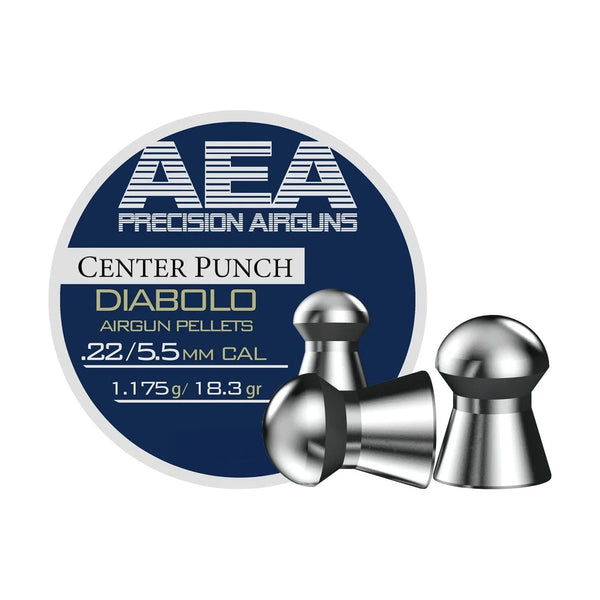
AEA Center Punch Diabolo Pellets .22 Cal / 5.5mm 18.3gr - 500ct
.22 Cal · 18.3 gr · 500 ct
$19.99

Last updated November 2026 · By the Northtac Team
Pellets or slugs is one of the first questions new PCP owners ask, and the forums don't make it easy. One thread swears slugs changed everything. The next says they couldn't get a single tight group out of them.
The short answer for most people is to start with pellets. Slugs earn their place once you're shooting past about 50 yards, dealing with wind, or going after bigger pests, but only if your rifle shoots them well. Below is how each one works, what they cost per shot and how to find out what your rifle prefers.
A diabolo pellet has a solid head, a narrow waist and a hollow skirt at the back. That skirt acts a bit like the feathers on a badminton shuttlecock. It creates drag behind the head, which keeps the pellet pointed forward without needing much spin from the barrel.
Slugs are solid, bullet-shaped projectiles, often with a hollow point or hollow base. There's no skirt, so a slug relies on spin from the rifling to stay stable. In return it slips through the air much more easily. Shooters describe that with ballistic coefficient (BC), and slugs usually have a higher BC than pellets of the same weight.
That higher BC means the slug holds its speed longer, drops less and drifts less in the wind. Up close you won't notice much difference. At 75 or 100 yards it starts to matter.
Most backyard and small-game shooting happens inside 50 yards. Plinking, paper targets and squirrels in the trees all fall inside that range, and a good pellet does all of it well.
Pellets are also more forgiving. Because they don't depend on spin, they tend to shoot decently in a wide range of barrels and at a wide range of power settings. If you've just bought your first PCP, that makes life a lot easier.
They're cheaper per shot, too. Our AEA Center Punch .22 18.3 gr pellets come 500 to a tin for $19.99, about 4 cents a shot.
The one thing to watch is speed. Pellets are built to fly below the speed of sound. Push a light pellet too fast and it can start to wobble or tumble, and your groups open up. If a light pellet isn't grouping in a powerful rifle, try a heavier one in the same caliber before you give up on pellets.
Pellets to start with
View all →.22 Cal · 18.3 gr · 500 ct
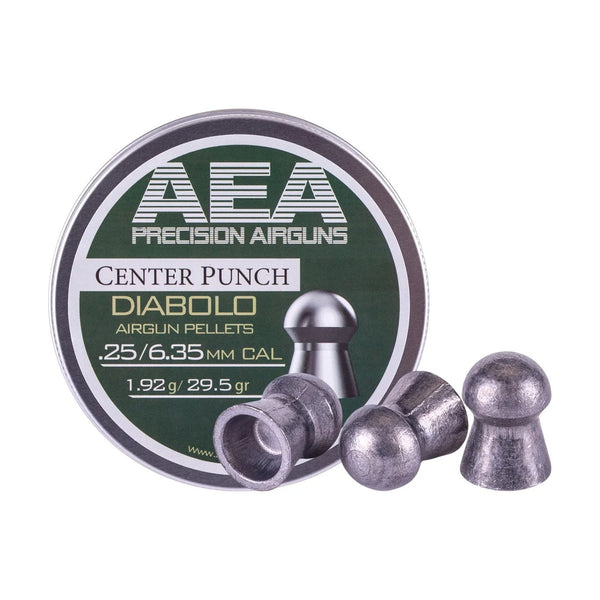
.25 Cal · 29.5 gr · 300 ct
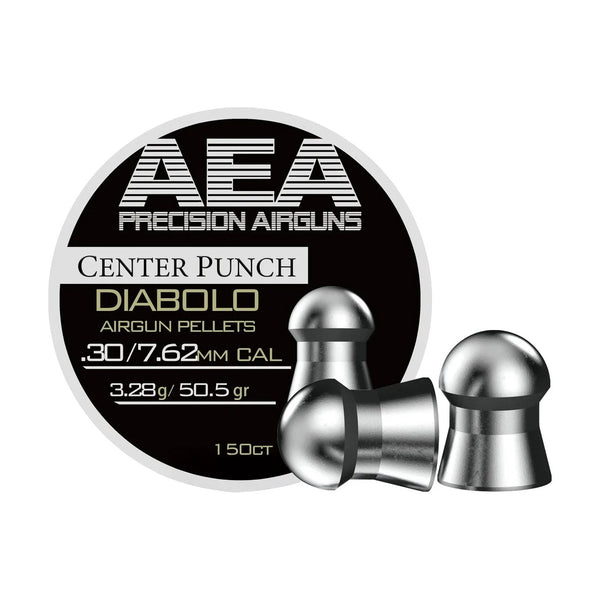
.30 Cal · 50.5 gr · 150 ct
Longer shots. If you regularly shoot past 50 yards, a slug's higher BC means less holdover and more energy left when it gets there.
Windy places. Open fields and hillsides rarely give you a calm day. A slug drifts less in a crosswind, so your misses are smaller when you misjudge it.
Bigger pests. For groundhogs or raccoons in a .25 or .30, a heavier slug carries more energy downrange. Shot placement still matters more than the projectile, and you should check your state's rules for anything you hunt.
Slugs ask more of the rifle, though. They need enough power to get up to speed, and they need a barrel with a twist rate that spins them fast enough. Some barrels love them and some never get along with them. Slugs also cost more per shot, and you'll want to try a few weights before you find the one that works.
Here's what our current AEA pellets and slugs work out to, rounded to the nearest cent.
In .22 a slug can cost twice as much as a pellet, or more. By .30 the gap is small, which is one reason slugs are so popular in that caliber.
Every barrel has its favorites, and the only way to know is to shoot a few. Pick two or three pellet weights and, if you're curious, one or two slugs in your caliber. Then test them the same way.
If your rifle has adjustable power, give slugs a fair chance by trying them at a couple of settings. Our QILIN BP rifles have a power adjuster with a lock and a regulator you can set between 70 and 200 bar, which gives you room to tune. A chronograph helps a lot here, because it shows if your speeds are consistent from shot to shot.
Slugs to test
View all →.22 Cal · 25.4 gr · 350 ct
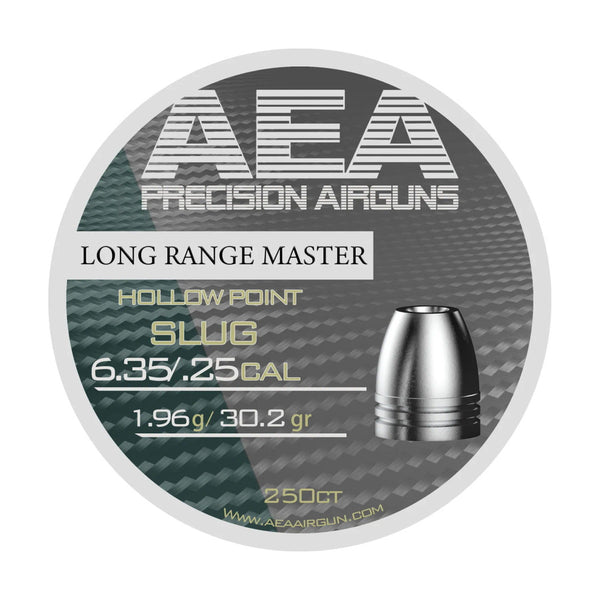
.25 Cal · 30.2 gr · 250 ct
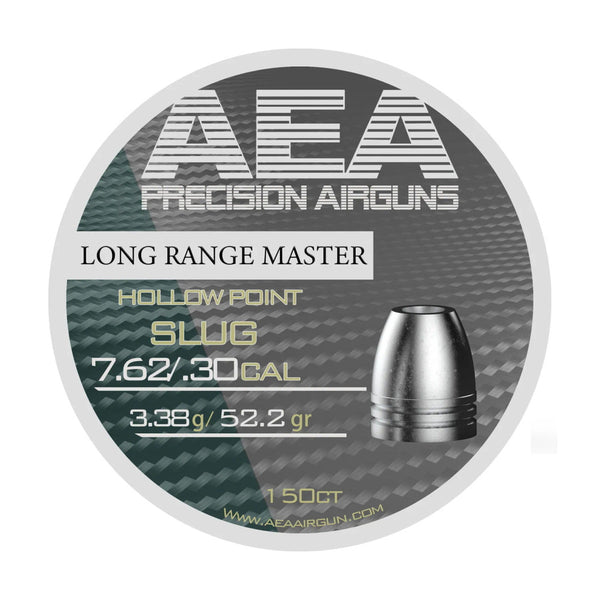
.30 Cal · 52.2 gr · 150 ct
Once you get to .357 and up, the choice mostly makes itself. Big bore air rifles are built around heavy slugs, and that's what we stock for them, from .457 166 gr Long Range Master slugs to .495 and .58. We still carry .35 and .357 pellets for lighter work, but most big bore owners shoot slugs. Everything is in our airgun slugs collection.
Not by default. At normal backyard distances a good pellet often groups as well as or better than a slug. Slugs pull ahead at longer range and in wind, if your barrel and power setting suit them.
You can try them in most regulated PCPs, but not every rifle shoots them well. Low-power rifles may not drive them fast enough, and some barrels don't spin them enough to stay stable. Test before you buy in bulk.
Start in the middle, around 18 gr, then try one lighter and one heavier. Our .22 Center Punch pellets come in 15.9, 18.3, 21.9 and 25.3 gr.
If you're not sure where to start with your rifle, send us a note or email support@northtac.com with the model, caliber and the distances you shoot. We'll suggest a few to try.